Rush- Live at The Laura Secondary School- Released in 2014 (But recorded in 1974) for Zoe Records
Best Song- Working Man
Though All The World's A Stage was the only live album released from 1974-1978, Rush had 4 live archive releases from that time, that weren't released until much later. The first of these was Live At the Laura Secondary School 1974, a live video (Yes, a professionally recorded video at a Middle/High school) recorded in April of 1974 for a TV program called Canadian Bandstand (likely a Canadian version of American Bandstand) and released in 2014 as part of the R40 boxset.
This is the earliest known live recording of the band, released before Neil was even a member, and when their debut album was only a month old. The band, however, still featured great playing skills even at this early age. Lifeson still rocked it on guitar. Lee's vocals are still not fully developed (He was just 20 at the time, they would come into his own around 1976, and stay at the top through 1978) but they still sound youthful and raw, and it works. John Rutsey's doesn't have the style of the "Professor", but his straight-ahead rock fit with the music they played at the time. And the performances themselves are excellent, featuring 4 songs from the debut ("Need Some Love", "Before and After", "Working Man" and "In The Mood"), one song that would later appear on Fly By Night ("Best I Can") and more interestingly, 2 unreleased songs ("I've Been Runnin'" and "The Loser") and a cover song ("Bad Boy"). The video quality is a bit fuzzy, but it doesn't harm the songs.
The album starts off with "Need Some Love" from the debut. This song is a vast improvement from the original, with an extended intro, much more power in the playing, and a faster tempo. We then get a real rarity, a live version of "Before and After" from the debut (The only known live performance of the song) and it sounds great, just as good as the nice studio version, with added rawness in the playing in the soft intro which sounds nice. The main rock section sounds good, too, as does the instrumental break.
We then go into an early, work in progress version of "Best I Can" which would later appear on Fly By Night. This version is a significant improvement from the original. The playing is the same, but Geddy sings in his natural voice, and not the comically masculine vocals of the original.
We then go into three real treats- three previously unreleased songs! The first is called "I've Been Runnin'", a great, if very generic, high-energy rocker, driven by a great riff and good singing. We also get some great shredding in the guitar solo, and a nice soft bridge with Geddy's getting the audience to clap along with him! Overall, a great treat, and it's worth buying this release for it.
The second is a cover of the Beatles' "Bad Boy". Their version of the song is a great, laid-back, bluesy take on the song, even if (Like most early Rush) it's pretty generic. The acapella choruses are also a nice touch, even if they're a bit silly. The song picks up near the end, with some more wicked shredding underpinning Geddy's screeching vocals. Unfortunately, we then go into a guitar solo. Why unfortunately, you may ask? Because unlike Lifeson's other guitar solos, which fit in with the song and are accompanied by the other instruments, this is all by himself, and is just a pointless, messy shred-fest. Bo-ring. Thankfully, this only lasts around 30 seconds, before the song comes to a close.
The third and final unreleased rarity is another original song, "The Loser". And it's another great one. The riff is solid, almost reminding me of "I Can't Explain", and Geddy's great singing accompanies a great melody. John Rutsey's drumming is great too, and we then get a nice guitar solo. Another great out-take. Shame there was never a studio version!
We then reach the highlight of the album, "Working Man". It's great! The opening riff is slower and heavier than the original, Geddy's raw singing adds roughness. The song gets much faster after the first verse, adding more intensity. We then go into another great jam section, with nice shredding over solid drumming. We have a SICK guitar/bass duel section in the middle, with KILLER bass lines. Overall, the jamming is excellent, never growing tedious. Sad Rush didn't do this sort of thing more often! The transition back to the main song is seamless, and we close out with a KILLER ending! Overall, a top-notch version of a Rush classic.
The band finally come back for an encore of "In The Mood". Geddy sings close to the studio arrangement this time, and the band plays the same, so it's not a big improvement, but it isn't any worse either. Overall, a solid close. Sadly, it cuts out near the end.
Overall, this live album is a must get. A fascinating document of early Rush, with great performances. An easy 5/5.
Thursday, March 24, 2016

Saturday, March 5, 2016
Rush- All The World's A Stage
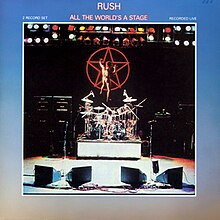
Rush- All The World's A Stage- Released in 1976 for Mercury Records
Best Song- 2112, By-Tor comes very close
Aside from the five studio albums released from 1974 through 1977, Rush had many live albums in the same period, and I will now go through them. First, In between 2112 and A Farewell to Kings, Rush released their first of many live albums, All The World's A Stage. This album consisted of the band's full performance at Toronto's Massey Hall in June of 1976. The album would continue Rush's rise to fame, charting number 40 in the US, and the "Fly By Night/In The Mood" medley would be a top 100 single.
As for the quality of the music itself, the performances are outstanding. Material is culled from each of the band's first four albums up to that point ("Finding My Way", "Working Man", "In The Mood" and "What You're Doing" from Rush, "Fly By Night", "Anthem", "By-Tor And The Snow Dog", and "In The End" from Fly By Night, "Bastille Day" and "Lakeside Park" from Caress of Steel, and "2112" and "Something for Nothing" from 2112). All of those songs were great in the studio, and they mostly sound just as good, if not BETTER than, the studio versions. Geddy's voice is in top form, (Most songs sound miles better, vocally, than the STUDIO VERSIONS) and the instrumental machine is cooking.
The opening "Bastille Day" kicks the performance off to a great start, sounding just as good as the stellar studio version, and a bit better in some places (Geddy pulls of some SICK screams here). "Anthem" is performed by the book, and is not really significantly better but since I loved the original, I love it here. We then go into "Fly By Night" which is just as great as the studio version. However, after two verses, we segue into "In The Mood". The transition works extremely well, as both songs have a similar sound. To make matters even better, "In The Mood" is a significant step up from the studio, with Geddy's mid-range singing in the original giving way to powerful screaming.
Next on the agenda is "Something For Nothing", which is another significant improvement from the original. Geddy's singing is leaps and bounds above the studio, and the guitar tone is much rawer than the studio, which rules. (Also, Geddy hits his highest note EVER in the first chorus, a B5). The song also gets a great extended outro, with great guitar lines. "Lakeside Park" is just as good as the very underrated studio version in the playing, and Geddy's singing is a significant improvement.
However, after all of these short songs, we then go into the main attractions, with four of the band's big epics closing out the disc. "2112" is first. It does have a few problems. It's much shorter than the original, as "Discovery" and "Oracle" are cut out, shortening the song by 5 minutes. The vocals also aren't as hot. But it does have lots of plusses. First, the beginning is INCREDIBLE. At the end of "Lakeside Park", Lifeson plays a few notes on guitar, and lets the last one hold out. It continues to echo, while Neil's chimes come in, and then the famous synth wooshing noises enter, while Alex continues to play heavily delayed notes.The tension at this part of the song is AMAZING, and further amplifies the impact of the opening song. We then go into the regular song. The opening riffing of "Overture" is played with far greater intensity, with Geddy's heavenly climb from the original giving way to a powerful scream. The vocals in the "Temples of Syrinx" section don't really sound as good as the original, but it doesn't harm the song. The "Presentation" section isn't much different from the original, but it sounds just as good. Lifeson's solo is also killer as ever, maybe more so. "Soliloquy" is just as good as the regular version as well, and Geddy's scream on "Spills OOOOOOOOOOOOVER" exceeds the original. And finally, "Grand Finale" is a bit weaker, as it doesn't have the doubled guitar tracks of the original, but it's fine. Overall, this is a great version of "2112", which you should definitely seek out.
Next is "By-Tor And the Snow Dog", which is extended from it's already lengthy 8 and a half minutes into a 12 minute monster. And it absolutely DESTROYS the original, and is easily near the best song on the album. The verses are stronger than the original, with much more power in the singing. We then go into the significantly extended "7/4 War Furor" section, which is the absolute centerpiece of the song. The jamming here is utterly FEROCIOUS, with INSANE riffs and licks being pulled off time after time. Lifeson shows that he could shred his ass off, and Lee's bass supports well. We even get riffs that would be included in "The Spirit of Radio" and "Cygnus X-1"! The drum sounds in this section are extremely cool as well. We then go into the "Aftermath" section, which is also MUCH better than the original, with absolutely CRAZY sound effects (Almost sounds like a SOLID WALL OF NOISE at one point), which have to be heard to be described in words. The reverbed guitar lines are also wickedly cool. "Hymn of Triumph" is also exceeding the original, as well, with so many great guitar lines pulled off. We then end off strong as ever. Overall, if you had to hear just one version of "By-Tor and the Snow Dog", pick THIS one.
Afterwards, we get "In The End". The beginning is played significantly differently from the original, with a quiet version of the main guitar sequence being played over Lee's significantly different singing. It's not as pleasant as the original, but it's nice. We then get into the funniest moment in the album. With heavy reverb applied to his voice, Lee introduces the heavier section with... "one...two...buckle... my... shoe". Comedy gold! And of course, this main body section is performed just as strong as the original. The ending features some really cool echo effects, as well.
The last of these four epics is 15 minutes of "Working Man", including "Finding My Way" (yay!) and a drum solo (boo!). Working Man's main section is performed much better vocally, with Lee once again singing much higher than the original. We then go into the jam section of the song. The jamming is ferocious, similar to By-Tor, with Lifeson playing insanely fast shredding. We then go into "Finding My Way", which is performed just as nicely as the great original. Geddy's screaming is also AMAZING, as he pulls off some INSANE highs (Topping out at G5) near the end. Then, it's back to the "Working Man" jam. The riff that plays in this section is great, and I can fist-pump to it any day. We then go back to the main song. The transition is effective as can be.
Unfortunately, we then go into the low point of the concert, the drum solo. I HATE drum solos. I'm sorry, I don't see the appeal of someone mindlessly bashing the kit for minutes. And this drum solo is no different. It's just Neil showing off how great he is by bashing the drums really fast with no structure, rhythm, or melody whatsoever. It's 3 minutes of boredom, and just wanting it to end. The woodblock section is cool, but that's it.
The show finally comes to a close with an encore, "What You're Doing". This song is much better than the original, with Geddy screaming his lungs out ("YOU SAY THAT YOU'RE FOOLING, WHO YOU THINK YOU'RE FOOLING NOOOOOOOOOOOW!") and a amazing groove.
Overall, this might seem like the recipe for a great album. The performances is great, the singing is great, and the set is great. So why do I give it a low grade? Well...
In my review of A Farewell to Kings, I mentioned that the album was really "ostensibly" live. The reason why is clear. ALMOST NOTHING REALLY IS LIVE. Pretty much ALL of the vocals were overdubbed in the studio (You can hear obvious double tracking throughout, sometimes you can hear them sing different notes!) and some instrumental parts too. (TOO studio perfect!)
I'm sorry. I really am. But as great as the performances are, a live album is only great if it's truly "live", not in the studio. And thus, I only give this a 3/5.
Sunday, February 21, 2016
Rush- A Farewell to Kings

Rush- A Farewell to Kings- Released in 1977 for Mercury Records.
Best Song: Xanadu or Cygnus X-1.
After 2112's smash success, Rush had their major breakthrough. They toured relentlessly between 1976 and 1977, going from support act to headliner, and releasing the successful ostensibly live album All The World's A Stage. (And by ostensibly live, I really mean it, most of the vocals were re-recorded in the studio). After the nonstop touring was done, Rush went to work on their fifth album, A Farewell To Kings. This album would be recorded in England's Rockfield Studios, with Rush being inspired by the British progressive rock scene of artists like Yes and Pink Floyd. This resulted in a very new sound for the band...
On this album, Rush dives headfirst into progressive rock. Though there were influences before, ("By-Tor And the Snow Dog", "The Necromancer", "The Fountain of Lamneth", "2112") most of their songs were pretty standard. However, here, Rush goes full-prog, filled with complex tunes, intricate and tight instrumental breaks, and constant abuse of the "Verse-chorus-verse" structure. Synths were starting to creep into the bands sound, appearing on every track on this album. Alex Lifeson was starting to incorporate more classical guitars into his sound, while Neil Peart expanded his drum kit to include diverse instruments like tubular bells, wind chimes, and wood blocks. The band also started experimenting much more with contrast, frequently balancing light acoustic and harder rocking sections against themselves.
On this album, Rush dives headfirst into progressive rock. Though there were influences before, ("By-Tor And the Snow Dog", "The Necromancer", "The Fountain of Lamneth", "2112") most of their songs were pretty standard. However, here, Rush goes full-prog, filled with complex tunes, intricate and tight instrumental breaks, and constant abuse of the "Verse-chorus-verse" structure. Synths were starting to creep into the bands sound, appearing on every track on this album. Alex Lifeson was starting to incorporate more classical guitars into his sound, while Neil Peart expanded his drum kit to include diverse instruments like tubular bells, wind chimes, and wood blocks. The band also started experimenting much more with contrast, frequently balancing light acoustic and harder rocking sections against themselves.
Thankfully, these heavy changes are ones for the better, and the album is another Rush masterpiece. Not only are the bands instrumental skills as good as ever, but so are the vocals, and the songs themselves, which range from good to absolute masterpieces.
The album starts off with the title track, and it's a great one. "A Farewell to Kings" starts off with a nice, pleasant acoustic intro, which leads into a fast-paced rock section. And this segment is great too, with a solid melody, more great guitar work, great singing, and good drumming. The instrumental break is great too, with nice bass guitar lines, and a good transition back to the "main" song. It's also cool that the lyrics end with the words "Closer to the Heart" which is a title for another song.
The next song, however, knocks it on it's back, being one of Rush's greatest songs ever. The 11 minute "Xanadu" opens with a incredible, astral intro of synths, and birds chirping in the background. This section does an AMAZING job of building tension, and by the time Lifeson's arpeggio guitar line enters at the 2 minute mark, backed by wooshing synth noises, the epicness of this section can't be described in words. It almost feels cinematic, like the intro to a huge, climactic action scene at the end of a movie. This chunk is easily one of the most epic, spine-chilling, mind-blowing, and incredible musical moments I've EVER heard, and definitely Rush's defining moment. The tension is finally released with a driving, hard rock section, which keeps up the greatness. The synth lines are solid, the guitar riff is great, and so is the drumming (the woodblock fill around the 3 and a half minute mark is one of my favorite Neil moments). Continuing with the action movie scene, this feels like the part where the group goes off to kick some ass. After this 5 minute intro, we finally get into the vocal section, which is about some bloke's quest to find immortality, but at the price of never leaving the titular, erm, "pleasuredome". The melody of this section is great, with solid vocal/guitar interplay. This section alternates between a hard driving rock section, and pleasant section featuring nice synth lines, with a reprisal of the driving instrumental in between the two verses. As a whole, this section isn't as good as the mind-blowing intro, but it's great as a whole, with great melodies, and great singing. (I love the way Geddy sings OOOOOOOOOHHHH! PARADISSSSSSSSSE!) We then go into the intrumental finale of the song, which has the same themes as before, but with wicked soloing on top. It then finally ends with a bit of the opening chunk, before closing with a pleasant coda. Overall, "Xanadu" is a magnificent prog epic. The only things keeping it from being above 2112 is the fact that it's shorter (2112 is 20 minutes long, compared to this song's 11, and has even more great musical themes) and how Xanadu isn't quite as epic after the 4 minute mark, while 2112 stays epic 'till the end. Overall, still an amazing song.
We then go into the mega-hit "Closer to the Heart", which i'm sure you've heard if you've listened to enough classic rock. This song is a nice poppy song, with a great uplifting melody, a great use of tubular bells, and a nice instrumental break to complement a great riff. This song would easily become one of Rush's signature songs, and has been played live since 1977 or so, with the only tours since where the song hasn't been played being the R30 tour, Snakes and Arrows tour, and Clockwork Angels tour.
The fourth song on the album is the Lee-penned "Cinderella Man" (Definitely not to be confused with the Eminem song of the same name). This song tells the story of a normal guy who became rich, and while it's not near the top, it's still a good song, featuring an almost "Pinball Wizard"-esque acoustic guitar line which alternates with a harder section, and a sing-along chorus which has an excellent riff. This song is, overall, quite underrated. The instrumental section is also nice, with great bass lines. (Geddy's bass playing really gets more presence on this album, and it's great!)
Afterwards, we go into a calm acoustic ballad, entitled "Madrigal". Most people don't really like this song, but I like it just fine. It's not the best on the album, but it's still good. It has nice, pleasant synth lines, good guitar strumming, and a nice, soft vocal performance. The bass playing in the background is also good, and the song picks up nicely with the addition of a drum beat in the background. The lyrics are really stupid ("When the dragons become too mighty to slay with pen or sword") but I don't care about lyrics, so...
The album closes with another 10-minute masterpiece, "Cygnus X-1", which is easily one of the best songs on the album (it's hard to choose between Xanadu and this. I say it's the former, but it's really close), a story of a man who travels into a black hole. It opens with an ominous synth intro, with bell sounds on top, as well as someone (Terry Brown) saying an ominous narration. This section of the song is a bit overlong, but it does a great job of building up tension. Afterwards, a melody starts building, as over this atmospheric sound collage, Geddy starts putting a WICKED funk bass groove on top inserted sporadically. This section gets even better as Neil and Alex join in, playing the riff. Similar to the Overture of 2112, the song then shifts through various musical themes, that are reprised throughout, and all of them are great, with assorted drum breaks scattered throughout. The rest of this "prologue" section consists of a great, menacing riff (Almost reminds me of the Imperial March from Star Wars) repeated, that builds more tension as it repeats, and Lee's bass and synths enter the mix.
Once this 5 minute instrumental intro comes to an end, we go to "Part 1" (Very bland part naming in this song), the first vocal section. This part is short, but good, with good interplay between Geddy's screeching vocals and Alex's guitar. The effects on his voice at the beginning also sound really cool, and the way this section ends (with the words "to soar" repeating again and again, with a cool spacey effect on top) is excellent. "Part 2" consists of a more upbeat, but also great, melody, with Geddy singing more insanely high pitched vocals, which then slows up into a KILLER wah-wah guitar solo, with great bass lines underneath. (If you're wondering why the descriptions of these parts sound so short, that's because they are. Part 1 is only 45 seconds long, and part 2 isn't much longer, at one and a half minutes)
"Part 3", however, is my absolute favorite part of the song, and one of my favorite passages in Rush's musical oeuvre. All of the instruments cut out, with only a quiet, but tense guitar line remaining, as well as wind sounds in the background, with occasional drum pounds. The tension to an absolutely mind-numbing level, which Rush never had and never did approach again. As the riff repeats, again and again, the tention builds... and builds... and builds, and then EXPLODES with a VERY heavy guitar line just BURSTING out of nowhere, topped by Neil bashing the drum kit with insane force, which is easily one of the most incredible passages in the ENTIRE Rush catalog, and demonstrates that no band was better at emulating chaos and destruction in their music. It seriously sounds like the music i'd play as the world crumbles all around me. The tension builds BACK up, however, as we shift to another repeating guitar line, over which Geddy's vocals return. The riff keeps repeating, again and again, which continues to build up the tension, which finally releases with Geddy screaming out "Every nerve is... TORN APAAAAAAAAAAART!" (Hitting the highest note in his career on "TORN APAAAAAAAAAAAART!", the Bb below Soprano C), which leaves nothing more than an ominous guitar line fading out. I'd be hard pressed to find a better use of tension in music. The musical merits are stunning by themselves, but what really makes the song great is how PERFECTLY the atmosphere of the song fits with the lyrics. The tense opening riff sounds just like the tension right before the launch. What's inside the black hole? Will I make it out alive? The upbeat, fast mood of part 2 makes it easy to picture the explorer speeding through space, and when it slows down, it perfectly matches him shutting off the engines as the black hole gains control. And the chaos in Part 3 definitely describes the chaos of the individual spiraling down towards the black hole. Overall, "Cygnus X-1" is an incredible epic, and definitely in my top 5 Rush songs of all time.
Overall, A Farewell To Kings is a masterpiece album, and a great intro to the band's new sound. If you haven't got this album yet, buy it now. You''ll be satisfied. 5/5.
Once this 5 minute instrumental intro comes to an end, we go to "Part 1" (Very bland part naming in this song), the first vocal section. This part is short, but good, with good interplay between Geddy's screeching vocals and Alex's guitar. The effects on his voice at the beginning also sound really cool, and the way this section ends (with the words "to soar" repeating again and again, with a cool spacey effect on top) is excellent. "Part 2" consists of a more upbeat, but also great, melody, with Geddy singing more insanely high pitched vocals, which then slows up into a KILLER wah-wah guitar solo, with great bass lines underneath. (If you're wondering why the descriptions of these parts sound so short, that's because they are. Part 1 is only 45 seconds long, and part 2 isn't much longer, at one and a half minutes)
"Part 3", however, is my absolute favorite part of the song, and one of my favorite passages in Rush's musical oeuvre. All of the instruments cut out, with only a quiet, but tense guitar line remaining, as well as wind sounds in the background, with occasional drum pounds. The tension to an absolutely mind-numbing level, which Rush never had and never did approach again. As the riff repeats, again and again, the tention builds... and builds... and builds, and then EXPLODES with a VERY heavy guitar line just BURSTING out of nowhere, topped by Neil bashing the drum kit with insane force, which is easily one of the most incredible passages in the ENTIRE Rush catalog, and demonstrates that no band was better at emulating chaos and destruction in their music. It seriously sounds like the music i'd play as the world crumbles all around me. The tension builds BACK up, however, as we shift to another repeating guitar line, over which Geddy's vocals return. The riff keeps repeating, again and again, which continues to build up the tension, which finally releases with Geddy screaming out "Every nerve is... TORN APAAAAAAAAAAART!" (Hitting the highest note in his career on "TORN APAAAAAAAAAAAART!", the Bb below Soprano C), which leaves nothing more than an ominous guitar line fading out. I'd be hard pressed to find a better use of tension in music. The musical merits are stunning by themselves, but what really makes the song great is how PERFECTLY the atmosphere of the song fits with the lyrics. The tense opening riff sounds just like the tension right before the launch. What's inside the black hole? Will I make it out alive? The upbeat, fast mood of part 2 makes it easy to picture the explorer speeding through space, and when it slows down, it perfectly matches him shutting off the engines as the black hole gains control. And the chaos in Part 3 definitely describes the chaos of the individual spiraling down towards the black hole. Overall, "Cygnus X-1" is an incredible epic, and definitely in my top 5 Rush songs of all time.
Overall, A Farewell To Kings is a masterpiece album, and a great intro to the band's new sound. If you haven't got this album yet, buy it now. You''ll be satisfied. 5/5.
Sunday, February 14, 2016
Rush- 2112

2112- Released in 1976 for Mercury Records
Best Song- 2112 (Particularly the Overture, Temples of Syrinx, or Grand Finale sections)
After the flop of Caress of Steel, it looked like Rush was done. Their live shows were flops (Only 1 bootleg exists from the tour!), their album was a flop, and the experience was miserable for their "Down The Tubes" Tour. Mercury Records urged them to switch to more hit singles. While they would eventually do that, now was not the time. Instead, Rush recorded 2112 at Toronto Sound Studios, opening with a 20 minute title track. Of course, this gamble paid off, giving them a hit.
As for me, I absolutely love this album. In terms of sound, this continues the "Hard rock with progressive influences" formula of the past two albums, but that is in no way a bad thing. Geddy's singing is just as great as ever, Lifeson's guitar work is just as stellar, and Neil's drumming still packs a mean punch. And the songs themselves are also excellent, with one particular 20-minute song leading the way.
The first song on the album is the 20 minute epic of the title track. And forgive me if I gush too much, but this is not only the best song in the Rush catalog, but one of my three favorite songs of ALL TIME (The others are The Show Must Go On and Shine On You Crazy Diamond) and that says a lot, right there.
The story goes as follows. In a world where all the music in the world is made by the government, one man finds a guitar, and thinks that it would be nice to allow people to make their own music. He shows it to the Priests of the Temples of Syrinx, but they say it's a waste of time, and smash it in front of him. The man has a
dream of when people could make their own music, realizes that life was better then, and commits suicide.
Sound stupid? It is. But the song itself is a different story entirely.
The song starts off with whooshing synth noises (The first time synths were used in Rush, but provided by guest Hugh Syme), before guitar riffing enters at 1 minute in, bringing you into the first part, "Overture". The synth part drops out soon after, and then we reach IT. The part where Lifeson delivers one of the most stunningly epic guitar riffs i've ever heard, backed with Neil's pounding drums and a heavenly ascending vocal part by Lee... This moment is not only the best part of the song, but one of my favorites in the Rush catalog. The song continues shifting through many musical themes, all of them outstanding, led by Lifeson's duel acoustic and electric guitar, and Neil's great drumming. (The 1812 Overture is quoted at one point) After about 3 incredible minutes of this, an explosion sound drowns everything out, with Lee delivering the words "and the meek, shall inherit the earth". And that's just the first 4 and a half minutes! This then leads into the second part of the song, and easily the most famous, "Temples of Syrinx", with Lee delivering quite possibly the highest vocal part he would ever do (And that's saying something!) backed by another excellent melody (The backing guitar in the chorus especially) and yet more great drumming. This section of the song deserves all the praise it gets, and the guitar breaks in between the verses are stunning. These first 7 minutes would essentially define the song in the minds of most, and Rush has performed at least this section on almost every tour.
However, it's only the beginning. After some gentle acoustic playing, we go into the third part, "Discovery". This section features a waterfall sound effect, over which we get some GORGEOUS, gentle guitar work, which gradually gets more complex. What makes this part so great is not just that, or the soft, gentle performance by Lee. (For a guy known for screaming his head off, he can pull off some BEAUTIFUL emotion!) What does is the little things. As the protagonist in the story discovers the guitar, the guitar part grows from single notes to chords, and eventually, a melody. The beginning even sounds like someone tuning a guitar! If i can find a song that has a better way of describing this kind of thing, you win something or other! After this soothing section, we get much harder as we go into the next section, "Presentation". Just like Discovery, it's all about the ideas they put into this. The song shifts between soft parts (The protagonist) and hard parts (The priests). After listening enough, It's easy to picture the guy walking up to the temple, presenting his guitar, only to be pushed away by the Priests. The transition works naturally, and part is Lee's singing. I always love it when one minute, he's doing some nice soft crooning, then the next we get "YES WE KNOOOOOOOOOOW, IT'S NOTHING NEW". The guitar solo is also some incredible shredding.
Afterwards, things calm down again, as we go into the fifth section, "Oracle: The Dream". This part of the song starts with a softer, calm part, before weird guitar noises lead us into a heavier part, supposed to represent the protagonist's dream or something. Though it's probably the weakest part of the song (Doesn't grab me as much as the other few) it is still great, (What a great song) with great vocal/guitar interplay. Plus, I really like the way Lee sings "I'VE SEEN THE HAND, OF MAN ARISE. WITH HUUUUNGRY MIND! AND OPEN EYES!
It then calms down yet again (What a crazy song! Rush really knew their mood shifts) and goes into the next section, "Soliloquy". As with before, this part starts out quiet, but turns louder near the end. But while "Oracle" was just great, this part is AWESOME. It is a slow, ballad section with a great guitar solo, a wonderful melody, and AMAZING emotional singing by Geddy Lee. This section perfectly illustrates the feeling of someone who is in despair, and doesn't feel he can carry on with life. After the protagonists "Lifeblood... Spills over..." We go into the final part of the song, Grand Finale. And BOY, is that a perfect term to describe this section! The song starts out with an upbeat (Why so upbeat? The protagonist just killed himself!) section driven by guitar, with some cool feedback noises in the background. This part is not to last, as we then go into a much more intense section, with Lifeson playing a repeating downwards scale over pounding drums. This section is wonderfully intense, and Lifeson's beyond incredible, extremely distorted lines which play over the scale are something to behold. But that's not all! The tension keeps building, and building, until the song breaks down into INSANE chaos, and I tell you, words can not describe how the very ending of this song (The part with the "ATTENTION ALL PLANETS..." voiceover) is. This section is the absolute best use of the "big rock ending" in a song, and i'm sure this is the music that plays while you're defeating the final enemy in your epic quest, with the world falling apart around you. Yes, it's THAT good. The song finally ends with a eerie, robotic voice repeating the words "ATTENTION ALL PLANETS OF THE SOLAR FEDERATION" and "WE HAVE ASSUMED CONTROL" three times each. (Amazing math bonus. 7 words X 3 is 21, 4 words times 3 is 12. 2112!)
So that's 2112, Rush's absolute greatest song ever (Most would probably give that title to "Xanadu", however). But wait, there's more! As hard as it may believe, there are *gasp!* other songs on here! The songs are more conventional rock then the monstrous title track, but while they can't compare to that masterpiece, they're good songs in their own right. "A Passage to Bangkok" is quite possibly Rush's only "drug song" with lyrics about going to various drug producing locations in the world. And it's a great drug song at that, driven by a WICKED oriental sounding riff, great singing, a nice chorus, and good soloing.
We then go into the next song, "The Twilight Zone", which has lyrics inspired by the (great) TV show of the same name. (Most people have probably seen it, but if you've somehow been living under a rock and haven't, you should, it's a stellar piece of classic sci-fi, sorry for the digression). And the song itself is good too! Geddy's singing is stellar, with a very low-key and dreamy feel in the choruses which sounds great (though the "nay nay nay nay" parts are a bit stupid), the riffing is nice, the soloing is good (Reaching some really high pitches at times!) and the whole song matches the show perfectly.
We then go into one of the few songs in the Rush catalog penned by Alex Lifeson, "Lessons". It's a nice, upbeat, laid back number with a acoustic driven melody in the verses which gets much harder (but still awesome) in the choruses. Geddy's singing is also crazy high-pitched here (NO! You didn't listen A-gain!) and the instrumental break is good. What more do you want?
We then go into Rush's first true ballad (Rivendell was also very soft and gentle, but I don't think a song about Lord of the Rings counts as a "ballad"), the Lee-penned "Tears". And while "Rivendell" was overlong and boring, "Tears" is simply BEAUTIFUL. Geddy's singing is extremely pretty, showing beautiful, soft delicacy that he rarely showed before, and it sounds breathtaking. The melody is also pretty, the mellotron strings in the chorus (Provided by Hugh Syme) add nice depth to the sound, and the chorus is nice. And there's also the harmonizing at the end... simply heavenly. Absolutely lovely.
We then go into another Lee-penned (But with Peart writing the lyrics) song, "Something For Nothing". And while "Tears" is soft and beautiful, "Something For Nothing" is pure heavy RAWK. And it's great. The bass part at the beginning is wonderful, one of the few times the bass is brought up to the forefront like this. We then go into the heavy pre-chorus section, which has a great melody, wonderfully aggressive singing by Geddy (It would be even better live!), and it leads into the nice sing-along chorus. A incredible scream by Lee leads into yet another killer guitar solo, which really rocks out loud. The rest of the song also features great melodies and riffing. A great closer to a great album.
Overall, an absolute classic album. Definitely Rush's best, and probably somewhere in the overall best as well. I can't give this anything less than a 5/5.
Saturday, January 16, 2016
MY REVIEW SYSTEM:
My rating system is on a scale of one to five. Here's how it goes.
5/5: Excellent, every song ranges from good to outstanding.
4/5: Good. A few stinkers, but mostly solid.
3/5: OK. Some songs are good, some are bad.
2/5: Mediocre. Most songs are poor, but a few diamonds in the rough.
1/5: Bad: Every song is mediocre to abysmal.
Simple!
When reviewing an album, I will mostly just take into account the quality of the melodies. I don't really mind bad lyrics in a song.
I also don't give a damn about if an album is "influential" or "Legendary" or whatever. I only pay attention to how good the songs are.
I will review music by band, not by album.
5/5: Excellent, every song ranges from good to outstanding.
4/5: Good. A few stinkers, but mostly solid.
3/5: OK. Some songs are good, some are bad.
2/5: Mediocre. Most songs are poor, but a few diamonds in the rough.
1/5: Bad: Every song is mediocre to abysmal.
Simple!
When reviewing an album, I will mostly just take into account the quality of the melodies. I don't really mind bad lyrics in a song.
I also don't give a damn about if an album is "influential" or "Legendary" or whatever. I only pay attention to how good the songs are.
I will review music by band, not by album.
Wednesday, January 13, 2016
Rush- Caress of Steel

Caress Of Steel- Released in 1975 for Mercury Records
Best song- The Necromancer.
In 1975, Rush looked poised for a mainstream breakthrough. They had some significant hits on their hands, they were touring relentlessly, and people talked about their rising stardom. It seemed a breakthrough was coming. And thus, Rush headed into Toronto sound Studios for work on their third album, Caress of Steel. Terry Brown produced as usual, and he would produce all albums through Signals. Of course, the album was a massive flop, and generally is regarded as one of Rush's worst, if not their worst.
But why? All the songs are top-notch, and the singing and instrumental work is as brilliant as ever. If you like Rush and Fly By Night, i have no idea why you wouldn't like this, and have NO clue why everyone hates this album so.
The album starts out with another great hard rocker, in the vein of Anthem, entitled "Bastille Day", and it's a great one. Lifeson's riffing has bite immediately, and the main song really rocks out, with a great melody and great singing from Geddy, delivering a very agressive performance. Neil's drumming is great as usual, and so is the guitar solo. The slow part at the ending is also fantastic. A great start.
The next song on the album is "I Think I'm Going Bald". Don't be fooled by the stupid name and stupid lyrics though! It has great riffing, similar to "In The Mood", and a nice melody. Everyone hates this song because of the stupid lyrics, but I don't mind it, and find it a great song. The guitar solo is... oh come on! I don't need to say that it's great again! (Lifeson is an amazing guitarist)
Afterwards, we get "Lakeside Park". This is another song everyone likes to hate due to it being an apparent "Fly By Night" ripoff, but i'm fine with it. The melody is great, Neil's drumming is nice, the guitar solo is nice,(Yeezus, will there ever be a Rush song with no guitar solo) and the singing is good! Do you really need anything more? The softer, more laid back middle is also pleasant. Good start!
We then get the first of two epics on this album, the three part, 12 and a half minute "The Necromancer". The first part, "Into The Darkness" starts poor, with pitch-shifted narration by Peart over a BORING backing beat. It then gets better though, with a cool, trippy section (4 minutes and 20 seconds long! Coincidence? I think not!) that almost sounds like Pink Floyd. It then picks up in intensity, but stays similar. This part is really good, with great lead and rhythm guitar and nice drumming. We then go into the next section, "Under The Shadow". This section starts with more terrible narration, but then goes into a really cool section, mostly silent, with sparse guitar hits, and It sounds awesome, especially as they become more consistent. We then have the vocals enter for a bit, before a nice guitar solo. We then go into another instrumental section, with more great riffs. Some weird sounds lead into some fast paced riffing, which sounds good, with some Yes esque parts. We then go into the final section of the song, "Return of The Prince", which starts with a nice, soothing, guitar riff. Even Neil's narration doesn't sound bad over it! it keeps this laid back tone, with some soloing over it, and it sounds wonderful. Overall, "The Necromancer" is another brilliant epic which is recommended.
The album closes out with the massive, 20 minute epic "The Fountain of Lamneth" which apparently tells the story of the lifelong quest of a man to find the titular fountain. We start out with the acoustic chunk "In The Valley", which is supposed to represent birth, followed by childhood. It starts with a pleasant acoustic melody with Geddy singing. It then picks up, with several guitar hits heralding in a harder section, before going into a faster tempo section, which sounds really nice! It then goes back to the softer part, and the transition is seamless. It then goes back to the harder section. This transition between light and hard works really well, and sounds awesome. It keeps doing this a few times. It then leads into the second part, "Didacts and Narpets". DEAR GOD, is this part pointless. It just consists of a random drum solo over which random words like "Work!" and "Live!" are shouted. The definition of filler.
After that disaster, the song has nowhere to go but up, and it does with the third part, "No One At The Bridge" which represents young adulthood. This section features great, emotional singing by Geddy, with a great, midtempo melody backing it. The arpeggio guitar riff is wonderful. As like "In The Valley" it alternates between harder and softer parts, and it works well. It then transitions to a vocal/guitar unison part, similar to the one in "Beneath, Between, and Behind" and it works just as well, with great interplay. Geddy's desperation in his voice is great too. This then leads to another great guitar solo. Then, birds chirping leads to the next part, "Panacea", which is supposed to represent finding love. Geddy does some of his lowest singing here, and the melody is nice and pleasant, but kind of boring. It can stick around, however. The fifth part is "Bacchus Plateau", which represents a mid-life crisis. This song is more uptempo, and it's still good, with another good melody. The drumming is nice as well.
We then finally go to the closing part, "The Fountain", which is supposed to represent old age and death. This part reprises many of the themes from "In The Valley" , and they're just as good here as they are there. It then has another simple acoustic part, ending with another guitar swell, representing death. Overall, it has some weak parts, and is not as good as "The Necromancer", but "The Fountain of Lamneth" is another spectacular epic.
Overall, a strong contender for most underrated album of all time. Everyone loves to hate on this album, and loves to call it one of Rush's worst, if not THE worst. However, I love it! Songs like "The Necromancer" or "Bastille Day" are among the greatest Rush songs of all time, and the rest are great. A wonderful album. 5/5.
Rush- Fly By Night

Best song- By-Tor And The Snow Dog.
After the hit of "Working Man", Rush managed to get signed to Mercury Records, and also managed to be able to go on tour.
Unfortunately, drummer John Rutsey's diabetes was taking a toll on him, and he was forced to quit. His replacement would be a mustachioed car parts dealer, one Neil Peart.
With Neil, the band headed back into Toronto Sound Studios to record their second album, Fly By Night, again produced by Terry Brown.
The addition of Neil would change the sound of the band significantly. As part of being the drummer, Neil would also start writing most of the lyrics for the songs. His book-smarts would heavily alter the lyrics, with the "Hey now baby, well I like your smile"'s of the debut giving way for "We marvel after those who sought, wonders in the world we wrought".
The second change would be in the music. The Led Zeppelin infused barroom fare of the debut would give way to a much more complex sound influenced by progressive rock bands like Yes, Genesis, Pink Floyd, and King Crimson, though still primarily based in regular rock. And it's top-notch, the band adapting well to this sound. Neil, of course, would become an awesome drummer, and even at this early stage his skills are in place, Geddy's singing is top-notch, and Alex is brilliant as ever. The songwriting is a slight step down from the debut (2 songs are okay, but not special, while one's really bad) but it's still good for the most part.
This transformed band is showcased on the first, and one of the best, song on the album, "Anthem", another favorite among Rush fans. Starting off with Lifeson playing a complex riff in an unusual time signature (it's definitely not 4/4), which transitions into a simpler section where Geddy Lee sings wordy lyrics well above the sane limits of male vocal range. And it's awesome! Lifeson's opening riff really sets the mood, the main verse sections are great, the guitar solo is great, and Geddy really lets it rip! ("WONDERS IN THE WORLD WE, WROOOOOOOOOOOOOOOOOOOOOOOOOOOOOOOOOOOOOUGHT! is awesome). My favorite part of this awesome song is the ending part, with Geddy screaming out "WRO-OUGHT! "WRO-OUGHT!" "WRO-OUGHT" over guitar hits. A really great way to start this album, and it works even better live.
The explosive start of the album is then followed up by the much simpler, more straightforward "Best I Can". It's kind of a mixed bag, unfortunately. The melody is great, but Geddy's singing really distracts me. He tries to put on a more masculine, gruff tone, and it sounds weird. Still, the song's fine overall, and Lifeson's guitar solo is brilliant as ever.
The third track on the album is "Beneath, Between, and Behind" . It's only 3 minutes long, but it's great while it lasts. The melody has interesting interplay between Geddy's vocals and Lifeson's guitar, with them hitting the similar notes and flowing together well. It really works, and the guitar solo is nice.
Next up, we have Rush's first attempt at a multi-part epic, live favorite "By-Tor And The Snow Dog". Though "Working Man" and "Here Again" also exceeded 7 minutes, they didn't have any specific parts, while this does. The main melody of part 1, "At The Tobes of Hades" is awesome, with great drumming by Neil Peart, great riffs, and great singing. What more do you want? This then leads into part 2, "Across the Styx" which is more of the same. After a brief instrumental part called "Challenge and Defiance", a powerful scream by Geddy brings us into the main instrumental break, "7/4 War Furor", which i guess is supposed to represent a battle. The weird guitar noises throughout kind of dampen the mood, but overall, it's pretty neat, with great guitar and drum work. This then leads into a cool guitar/drum battle sequence, which really rocks. After a crash of noise, we head into a peaceful section called "Aftermath". It's a very trippy, cool section that almost reminds me of the later "Xanadu". It then builds up into an epic, guitar led section, with Neil's funeral drum esque beat driving. After a cool sounding drum solo, we go into a slow, rock section, called "Hymn Of Triumph". It features another awesome, guitar-led melody. This might be my favorite part, as the melody is EPIC! We then finally end with "Epilogue", a reprise of the main theme at the beginning, ending with wind chimes. (Fun fact, on vinyl, these would be put in the run off groove in side 1, which made them go on forever!) Overall, a spectacular epic, and a clear sign of things to come.
This is then followed up by the cheerful, poppy title track, Rush's best selling song. It's a great one, with a nice guitar riff, a solid melody, and an overall great sense of optimism. The guitar solo is neat too, and the bridge is nice, with cool phasing effects on Lee's voice. Overall, it's not hard to see it's success.
Next up is a much more obscure song, "Making Memories", which is a much softer, folkier song. It works well, with a nice melody and good guitar solo, but it's not one of the highlights of the album.
It's still better than "Rivendell", which is the only bad song on the album. The song's main melody is REALLY pleasant and beautiful, but it drags on FOREVER! It's only five minutes long, but it feels like 50. It's so BORING! Rush would do good softer songs later on (E.G "Madrigal" and "Tears") but this is not one of them.
Thankfully, the album closes on a high note with another epic, "In The End". It starts off with a softer section, which is great, with nice singing by Geddy Lee and a great melody. It then moves on to a more hard rock section, which keeps the same basic melody as before, but harder rocking. The rhythm guitar in the background is great, the singing is great, and the arpeggio guitar melody is great. Nice! The guitar solo (Man, does EVERY rush song have a guitar solo?) is good too. It ends with another soft section.
Overall, a bit less consistent then "Rush" (5 great songs, 2 ok to good songs, 1 bad song) but it's still great overall. 4/5.
Subscribe to:
Posts (Atom)